Inside a Swedish training camp
Sweden has long been one of the great table tennis nations. For decades, it has produced players capable of competing with – and beating – the very best in the world. Think of names such as Jörgen Persson, Mikael Appelgren, Stellan Bengtsson and, of course, the GOAT himself, Jan-Ove Waldner. More recently, Truls Möregårdh has continued that tradition, putting Swedish table tennis firmly back in the spotlight on the world stage.
But what makes Sweden so good at table tennis? What does their training actually look like? Is it the drills, the intensity, the coaching, the environment – or something less obvious?
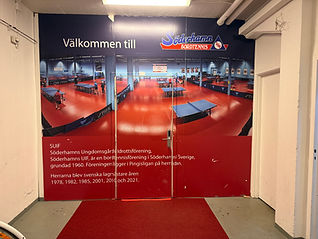
I recently had the opportunity to find out first-hand when I was one of the coaches accompanying eight young British players from the DiSE programme to a training camp in Sweden. Our base was Söderhamns UIF, one of Sweden's most successful table tennis clubs and seven-time winners of the Swedish Pingisligan.
Leading the sessions throughout the week were Peter Blomquist, who has been part of the Swedish national coaching set up for 25 years, and Thomas von Scheele who represented Sweden in the men's doubles at the 1996 Olympic Games and, alongside Peter Karlsson, became World Champion in men's doubles in 1991.
So, before we had even hit a ball, we knew we were entering a pretty special table tennis environment. That was confirmed when we walked into the impressive 18-table training hall and saw Jon Persson warming up – a player who reached a career-high world ranking of 38, is a four-time Swedish champion and was part of Sweden's gold-medal-winning team at the 2023 European Team Championships. Our first session started at 7.45am and the English players were immediately paired with Swedish players. From the first ball, the intensity and energy were incredibly high.
But one of the things that interested me most as a coach was the structure of the practice. The

first drills went straight into irregular footwork. Traditionally, I might start with regular footwork patterns before progressing into something less predictable. Not here. Almost immediately, players were being asked to move, react, read the ball and make decisions. It made me question some of our more traditional approaches. Why spend so much time practising predictable movement patterns when the game itself is anything but predictable? That became a recurring theme throughout the week. There was plenty of semi-regular practice, but exercises quickly developed into open play. Players might know where the first few balls were going, but then the rally would become unpredictable, requiring them to read the situation and make decisions. There was structure, but it rarely stayed predictable for very long.
Another instruction that really stayed with me came during a session when players were told to work at around 70% rather than going all out. It was a reminder that high-intensity training doesn't necessarily mean hitting every ball as hard as possible. The emphasis was on quality, control and consistency – maintaining good technique, extending the rally and giving both players a high-quality practice.
There was also plenty of match play. Early in the week, players competed in two best-of-seven matches against opponents of a comparable standard. This wasn't just about winning or losing; it helped establish the most appropriate sparring partners for the remainder of the camp. Again, the quality of practice wasn't being left to chance.
Another aspect of the Swedish approach that I particularly liked was the amount of responsibility given to the players. During some sessions, players were given the freedom to choose exercises based on what they felt they needed to develop. There was still a framework – serve, return and first attack had to feature – but within that, players were expected to make decisions about their own training. The coaches provided the structure and expectations, but the players were expected to take ownership of their development.
Perhaps one of the most impressive aspects of the week, though, wasn't a particular drill at all. It was who was in the room. During one of our sessions, Jon Persson, Viktor Brodd, Jens Lundqvist and Hampus Nordberg were all training alongside us. For our young English players, that was a fantastic opportunity. These experienced players weren't hidden away in a separate elite training centre. They were in the same hall, on the same tables and part of the same training environment. Our players could see first-hand how top players prepare, the intensity they bring and the standards they expect from themselves. Sometimes young players can learn as much from simply being immersed in the right environment as they can from another piece of technical coaching. It also sends a very simple message: No matter how good you become, you still turn up and train.

And that brings me back to the question I had before the trip. What makes Sweden such a strong table tennis nation? Having spent the week watching the training first-hand, I realised that there is nothing magic or mysterious about the coaching methods. There wasn't a secret Swedish drill we had never seen before. There wasn't a revolutionary coaching technique that suddenly explained decades of international success. Many of the exercises would be familiar to coaches and players everywhere. The difference was the environment in which that training takes place. These players have access to high-quality coaching, excellent facilities and strong sparring partners – and, crucially, they have access to them consistently. Talented young players can walk into the hall and practise alongside experienced international players. They don't just hear what high-level training should look like; they see it and experience it every day. And the volume of training is significant. Many of these players have access to this environment for two sessions a day, at least five days a week. And they turn up. That may be the biggest lesson of all. You can have the facilities. You can have knowledgeable coaches. You can have world-class players available as sparring partners. But none of it matters unless players are prepared to consistently walk through the door and put in the hours.
The Swedish approach I experienced wasn't built around a magic formula. It was built around some very simple principles: quality, intensity, consistency, decision-making, responsibility and opportunity. For our eight British players, it was a fantastic opportunity to experience that environment, test themselves against Swedish players and see first-hand the standards required. For me as a coach, it was just as valuable. Sometimes the best coaching experiences aren't about coming home with a notebook full of new drills. Sometimes they simply make you look differently at the things you already do.


Comments